I was sitting in a room filled with ‘healers’, one of which had verbally assaulted me a month or so previous. I wasn’t super comfortable being there, but a friend offered me a seat next to her, the furthest point away from my offender.
I was managing my anxiety well and taking my power back as I sat there. At one point the offender was sharing a painful part of her story. My friend leaned over to me and said “I just heard ‘hurt people, hurt people’ and I could feel her soften towards my offender.
My offender’s story is heartbreaking, and I’d had that same compassion and understanding when she first shared it with me. So much so that when she asked me something very personal, (that was really none of her business) I took the chance to be open and honest in sharing something I don’t share with others. I shared how ashamed I was and how I’d allowed myself to be influenced by someone who wasn’t who she had pretended to be.
Instead of meeting me with the same compassion and understanding I gave her, this person judged me, shamed me and literally told me to ‘FUCK OFF’.
It’s important to note her heartbreak was not recent. This was not someone in the midst of grief; this is someone who chooses not to heal from it.
There is grace we extend to those who are in immediate emotional crisis. Lashing out, saying things that are atypical of their norm, these are understandable in the moments during/after an emotional crisis. An emotional crisis upsets one’s equilibrium, and it takes time to find one’s balance in the new world, post crisis. We give others our compassion and understanding during this time.
Years later, however, this same behavior is not acceptable. It is unacceptable, no matter how horrid the tragedy. Why? Because we as adults are responsible for our behavior, and by extension, our healing. It is one thing to hold onto the pain, it is quite another to weaponize your pain to harm others.
If she had punched me in the face instead of hurling judgement and verbal abuse at me, would my friend have dared to say, ‘hurt people, hurt people’? I think not.
Trauma Diminishing And Care Deferred
If ‘hurt people, hurt people’ was a true statement then we would have to look at some of the ugliest people of our history with compassion and understanding, too.
- Hitler
- Slave Owners
- Colonists
- Jeffrey Dahmer
- John Wayne Gacy
Just to name a few.
But we don’t do we? We don’t ever say about some school shooter “Awe, he must be hurting. Only hurt people, hurt people.” How would a parent feel to hear that regarding the person who killed their child? How would Jews feel if we offered that about Hitler? Etc. Etc. Etc.
Saying ‘hurt people, hurt people’ to someone who has just been wounded in some way, by another’s words or actions is gaslighting. It is telling them their being wounded is justified because of another’s pain. It perpetuates ‘trauma diminishing’ which is in fact gaslighting. A technique whose premise is to dismiss your pain based on someone else’s pain being greater.
There is a time for triage. Sure.
In an emergency room if you have a broken arm and someone else comes in with an amputated arm it is appropriate to rate the severity of each injury to ascertain a priority.
A priority. When you are in a situation where the treating resource is limited (ie; medical staff on duty at the time of emergency), then prioritizing is necessary to provide the best outcomes of ALL. Prioritizing does NOT DISMISS the broken arm because the amputated arm is a higher priority! It doesn’t send the broken arm home with an ‘oh well, you’ve been out-traumatized, therefore you don’t get our support.’ Nope. It doesn’t do that.
You might have to wait a bit to receive care and compassion, but you will receive it. Care is not deferred because someone else is hurting more. But when we use the phrase ‘hurt people, hurt people’ to try to diminish someone who has just been affected, it is indeed ‘care deferred’.
Emotional Wounds
Emotional wounds are obviously more difficult to assess than physical ones. This is why it is best not to do triage on emotional wounds and accept whatever the victim states is their pain level. Let’s not compare one’s emotional wound to another.
Why?
Because no two emotional wounds are the same. A physical trauma has documented and outlined descriptions that are defined for the purpose of diagnosis and cure. It is necessary to gather the symptoms the patient is experiencing to identify the imbalance and recommend a course of treatment to cure the issue. A ‘broken arm’ is a ‘fractured humerus, ulna or radius’ anything else and it isn’t a broken arm.
But a broken heart? Where is the definition for that found? A broken heart could be a fractured love connection, the loss of a parent, grief over a deceased pet. It could be the loss of a spouse of 2 years or 52. It could be the loss of a miscarriage or the death of your 24 year old son, or your 56 year old daughter. Even if two 45 year old women are presenting with the sudden loss of their mothers, they do not have the same wound. How would you go about suggesting a cure for any of these?
That’s a trick question because there is no cure for these things…but there is healing.
The difference between the amputated arm and the broken arm is that the broken arm will heal and no one will know by looking at you, that your arm had ever been broken. But an amputated arm is noticeable to all. The broken arm does not change your self-identity, but the amputated arm surely will.
In the emotional or spiritual realm these differences exist as well. There are ’emotional breaks and emotional amputations’. What differs in the emotional realm is they are ALL invisible to others. Whether they are emotional breaks, or emotional amputations, they are invisible to others. They can only been seen through the x-rays of vulnerability. The victim is the doctor who assesses whether or not this is an amputation.
Grief, by all accounts, is an amputation, because something that was present, is no longer present.
Healing
Amputations require special healing because while the wound may close over with time, that is not the entirety of the healing. Healing from an amputation requires therapy to regain balance, to relearn how to do daily life, but most importantly it requires one to answer the ‘who am I now?’ question. Healing from an amputation requires recreating your self-identity.
If you skip that part, if you ignore that part, if you avoid that part, you will not heal. Your emotional self becomes infected with bitterness, anger, and rage and eventually gangrene sets in. This will ensure that you go around dripping your infection on everyone else, creating fresh wounds in others.
We cannot excuse poor behavior because that allows the gangrene to continue. It is a disservice to the one who has chosen not to heal.
We cannot excuse it with ‘hurt people, hurt people’, or ‘that’s just how he was raised’, or ‘she doesn’t know any better’. It’s as bad as saying to a grieving widow, ‘he’s in a better place now.’ We. Just. Don’t. Say. It.
When my friend said that to me, I simply replied ‘I know.’ I didn’t go off on her. I didn’t even say to her anything that I’ve written here. Because she had good intentions, yes. But also because her experience of this woman is different than mine and I don’t need to recruit her to my experience. Maybe, if she has compassion towards that woman (because my friend had definite judgements when I told her what had happened), then maybe SHE can approach her with compassion and maybe THAT might start this other woman’s healing. Maybe, but also, maybe not. The treatment for an emotional amputation will always be kindness and compassion, but the healing of it requires something more.
Treatment = kindness + compassion
Healing = kindness + compassion x integration
Treatment is something that others give to an injured party which will be totally ineffective if the patient refuses to integrate it. The medical personnel can provide the antibiotics and pain meds, but the patient must take them in.
Same with compassion and kindness. They can be presented, but if the patient knocks them away (which is how I envision my experience with this woman) then no healing can take place. It is not the medical personnel’s job to force feed the medication to the patient. The patient has the right of self-determination. It is not my job to convince this person to accept my kindness and compassion.
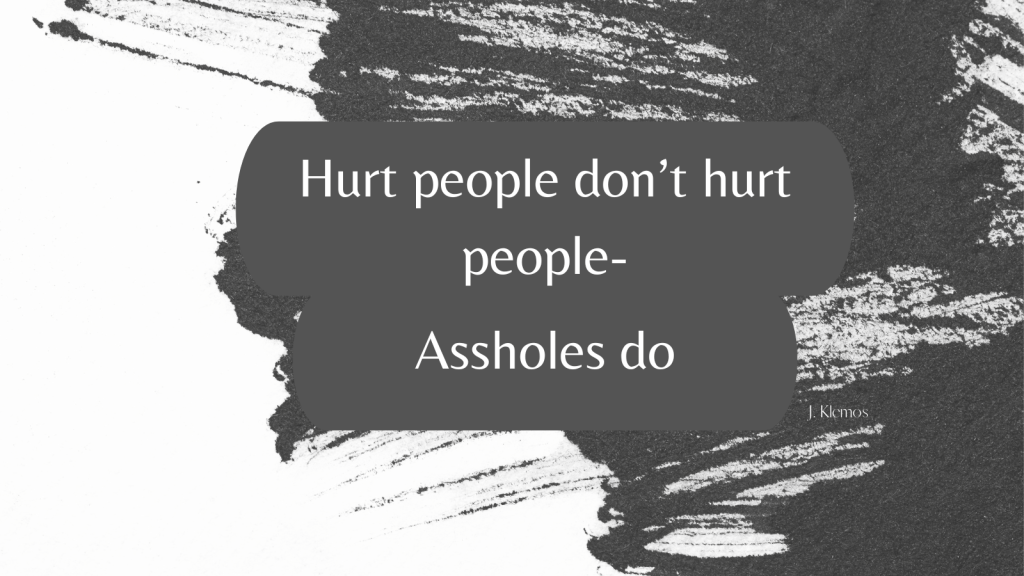
I know this is going to sound really hard hearted, but people who hurt people are assholes. There’s no way around it. I have SO MUCH respect for the hundreds of people I encounter who have done their healing and turned it into something amazing. Consider the founder of MADD who turned her grief into a national foundation.
Be An Ocean
To use a cliché, you can let events of your life make you better or bitter. It’s that simple.
Not allowing yourself to heal by either rebuking the kindness and compassion offered you, or turning your pain against yourself, makes you a liability. It actually makes you a prisoner of that event/pain.
Just as a desperate prisoner will take a toothbrush and turn it into a shiv, the woman in my encounter took my share and stabbed me with it. Because of the choices she made to remain captive of the events of her life, she chooses to lash out at others. It is a survival mechanism, but just as many prisoners never make a shiv out of their toothbrush, there are many in pain who never choose to lash out at others.
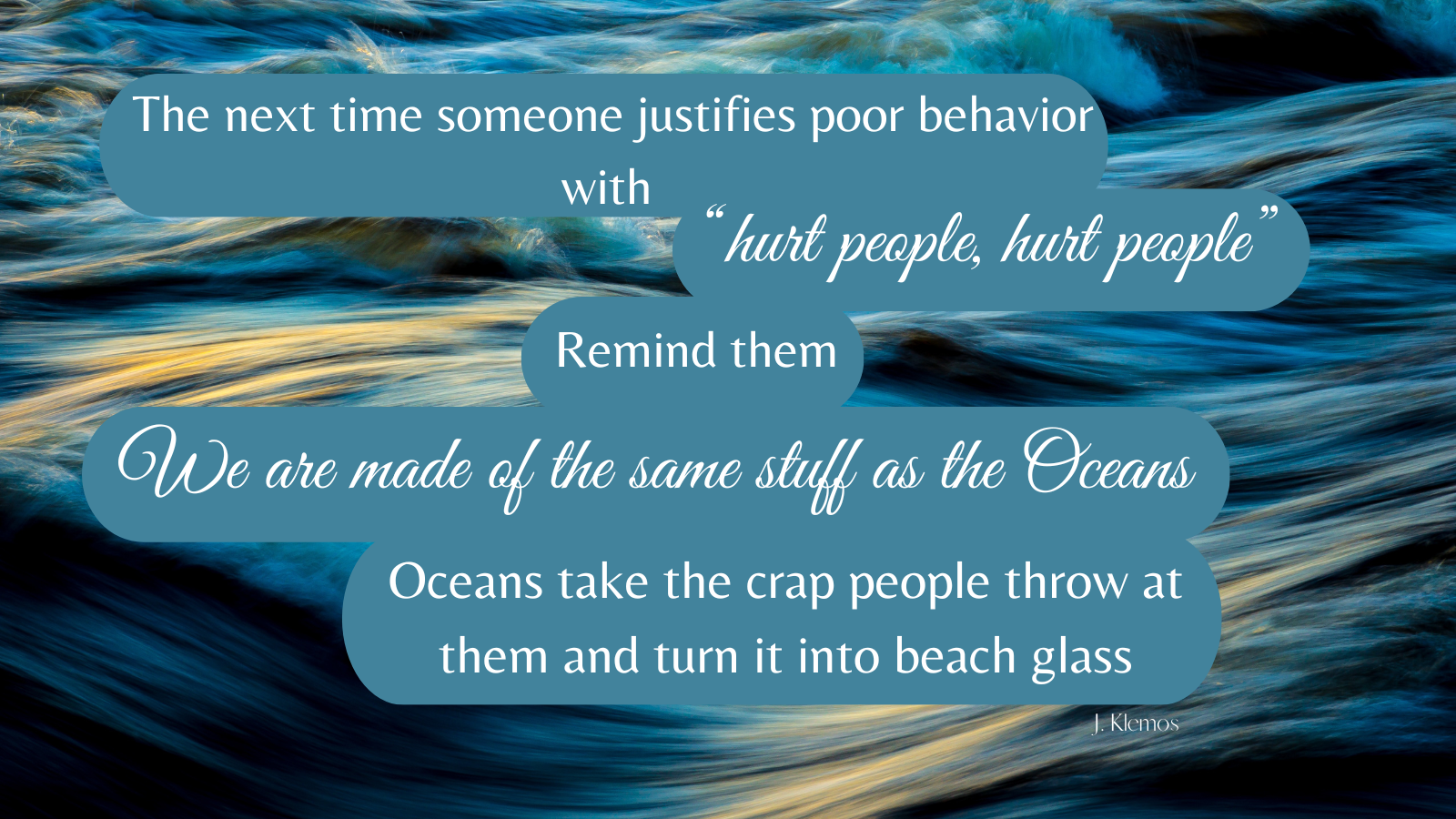
Other people are like oceans. Oceans take what people throw at them and return it to the shore as beach glass. The ocean literally takes trash and turns it into treasure. The ocean takes shards of glass polishes it, smoothes out the jagged edges, and gives it to the world as art.
We can do this with our pain also, if we allow ourselves the right care to heal.
Every. Single. One. Of Earth’s inhabitants has endured some sort of loss, pain, grief, trauma and/or tragedy. Every. Single. One. Every. One. Without exception.
The next time you are walking somewhere with a lot of people, try to look at others as fellow wounded beings. See their courage to heal. See their capacity for deep love. Recognize you are not the only person with wounds.
Now, each individual will identify with their experiences differently and choose to have it alter their path in different ways. Some will use negative coping like denial, drugs, alcohol, sex, or recklessness. Some will utilize positive coping like crying, venting, writing, therapy, exercise, or groups. The ‘who’ they become will vary greatly between the groups. One group will become Prisoners, the other will become Oceans.
The Prisoners are the ones who will spread pain around.
The Oceans are the ones who will make art of their pain.
Be an ocean.
Love, Jade


 The Village Healer
Leave a comment